
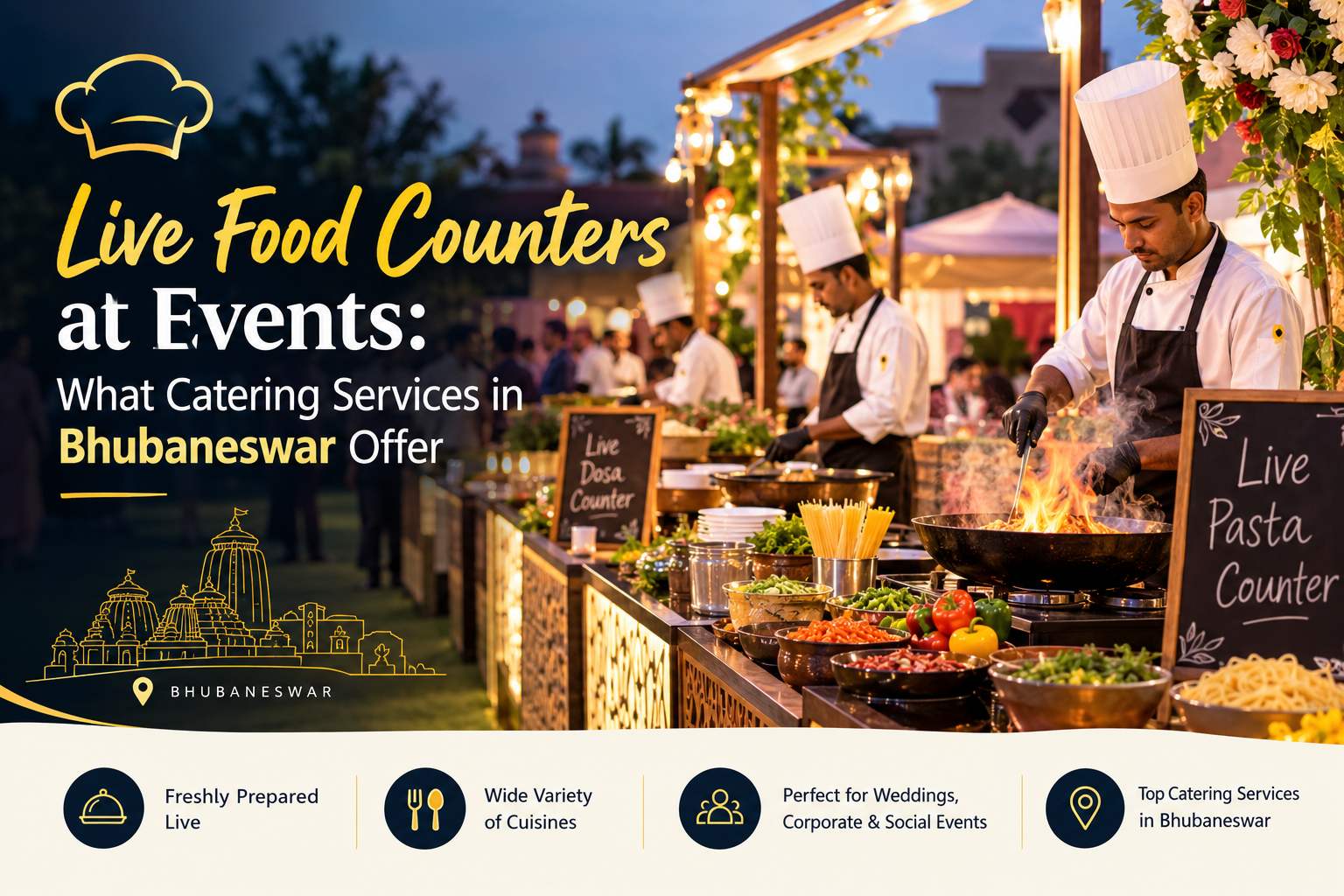
Live Food Counters at Events: What Catering Services in Bhubaneswar Offer
A few years ago, a buffet of steel containers was the standard at most celebrations. Today, guests expect something more theatrical: a chef flipping dosas, a counter of sizzling chaat, a pasta station where the sauce is tossed to order. Live food counters have moved from novelty to expectation, and most catering services in Bhubaneswar now offer them in some form. Understanding how they work will help you decide whether they suit your event and how many you need.
What is a live counter?
A live counter is a station where food is prepared or finished in front of guests. Instead of dishes sitting in warming trays, a cook makes each portion to order. The food is hotter and fresher, and the cooking itself becomes part of the entertainment. Guests watch, chat with the chef, and often return for a second helping.
At Sumangalam Caterers, we introduced customised menus and live counters back in 2015, when the idea was still fairly new in Odisha. Over the years we have refined how they are staffed and positioned, and the lessons from that experience guide the advice below.
Popular types of counters
Chaat counters, with items like pani puri, dahi puchka and tikki, are perennial favourites, especially in warmer weather. Dosa and uttapam stations offer a South Indian touch and are popular at weddings with mixed guests. Tandoor or grill counters serve kebabs, tikkas and breads fresh from the oven. Noodle, pasta and momo stations appeal to younger crowds. Dessert counters, with hot jalebi, rabri or freshly made waffles, are often the star of the evening.
The best choice depends on your menu and your guests. Variety is nice, but resist the urge to add too many counters. A few well-run stations beat a crowded hall of mediocre ones.
How many counters do you need?
A common mistake is placing too few counters for the number of guests, which creates long lines and frustrated people. As a rough principle, each counter can serve only so many portions per hour, depending on the dish. Dosas and grilled items take longer than chaat. Ask your caterer how many guests each counter can handle and how many cooks will staff it. For larger events, popular items may need two stations to keep queues short.
Space, power and logistics
Live counters need physical room, and they bring their own requirements. Tandoors and grills need ventilation and a safe distance from guests. Stations using gas or electricity need reliable supply, and a backup in case of a power cut. They also need water access, waste containers and a clear path for replenishing ingredients.
Visit the venue with your caterer, or choose one the team already knows. Sumangalam’s partnerships with eight Bhubaneswar venues mean we already understand the layout, power points and constraints of many of the common wedding and party locations.
Managing queues
Queues are the hidden problem with live counters. If guests stand in line too long, the novelty turns into irritation. Good caterers reduce this by placing counters in different corners rather than clustering them, by pre-preparing components so that final assembly is quick, and by using attendants to guide guests. A small sign listing the dish and ingredients also reduces questions at the counter.
Food safety at live stations
Because food is prepared in the open, hygiene matters even more. Cooks should wear clean uniforms and caps, handle food with tongs or gloves, and keep raw and cooked ingredients separate. Ingredients should be kept covered and, where necessary, chilled until needed. Ask how the team manages these details, since the best catering services in Bhubaneswar treat them as routine.
Cost and value
Live counters are generally priced separately from the standard menu, because they need additional staff, equipment and fuel. This is one reason to ask for itemised quotes. Some hosts add counters for the entire event, while others limit them to a few hours, such as the dinner window. If budget is tight, choose one or two that your guests will truly enjoy rather than spreading the money thinly.
When counters might not suit
For small family gatherings or religious ceremonies with a simple menu, live counters may feel out of place. Likewise, if your venue is cramped or has no suitable ventilation, a conventional buffet could be more practical. A caterer who recommends fewer counters rather than more is often looking after your interests.
Making the most of them
The best way to use counters is to treat them as an addition to a strong core menu, not a replacement. Guests still want a satisfying main meal. Counters add flavour, freshness and a sense of occasion on top of it.
Questions to ask before adding counters
Reducing waste with made-to-order food
One quiet advantage of live counters is that food is prepared as it is requested. This usually reduces leftovers, since the kitchen does not have to guess how much of every dish will be eaten. Guests take only what they want, and the counter cooks only what is needed. For hosts who dislike waste, this is a strong argument for adding a counter or two. Ask your caterer how they plan quantities, since the best catering services in Bhubaneswar treat this as part of good planning.
Pairing counters with the rest of the menu
Choose counters that complement, rather than repeat, your main dishes. If your buffet already includes fried snacks, a fresh chaat or fruit counter offers contrast. If the main course is rich, a light grill or salad station gives guests balance. A well-chosen mix keeps the whole meal feeling thoughtful rather than crowded.
Ask the caterer how many cooks will staff each counter, how long a typical portion takes and what the plan is if a counter runs out of an ingredient. Ask to see photographs or visit an event where the same counters were used. A confident caterer will answer in specifics, and you will learn a great deal about how well the catering services in Bhubaneswar you are considering actually run their live stations.
