
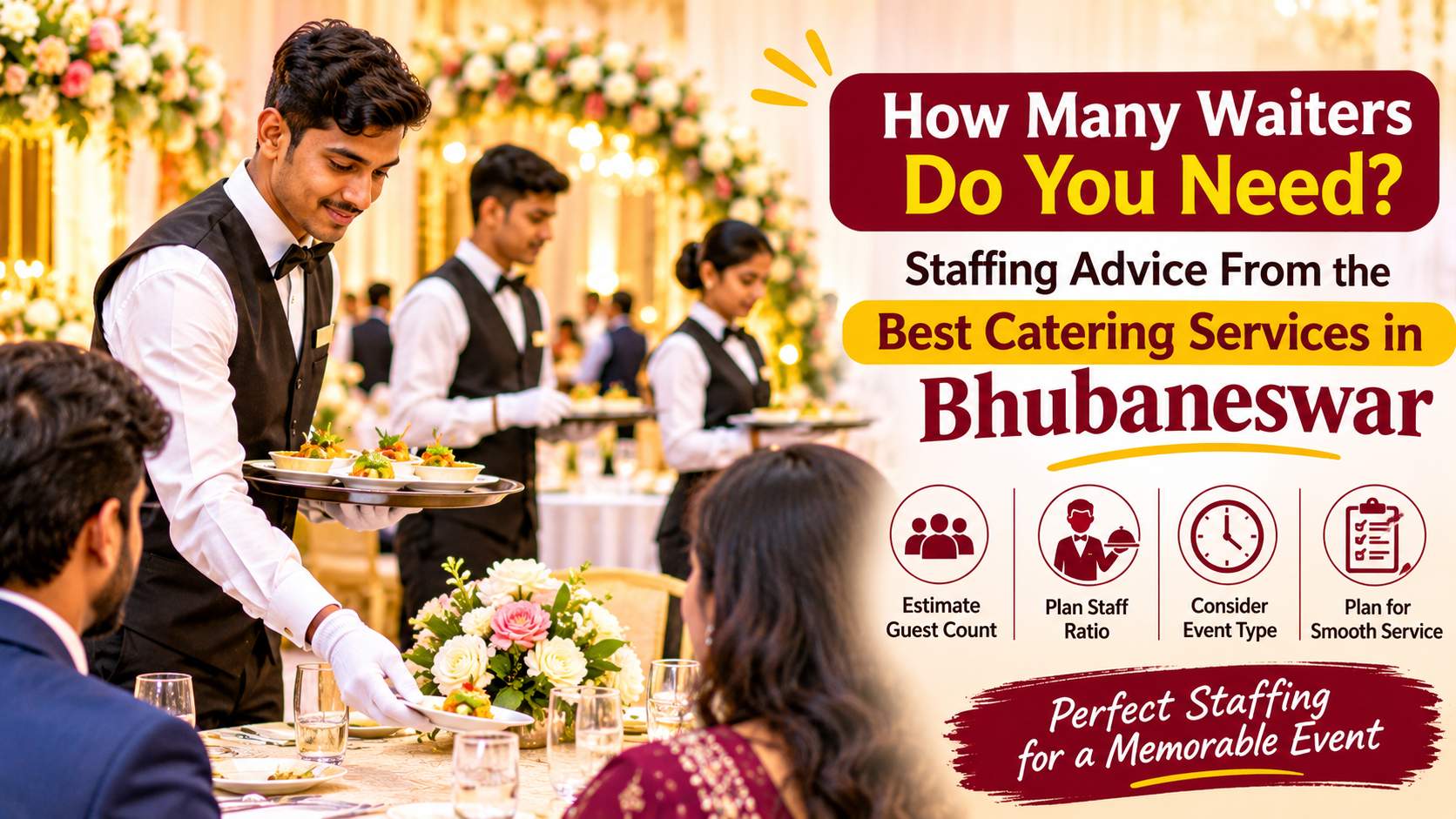
How Many Waiters Do You Need? Staffing Advice From the Best Catering Services in Bhubaneswar
For a buffet, plan roughly one server for every twenty-five to thirty guests, plus extra hands for live counters and the kitchen. Plated or thali service needs about one waiter for every ten to fifteen guests. The exact number depends on the venue layout and the menu.
Ask any experienced event manager what ruins a good meal and the answer is rarely the food. It is the wait. Guests stand in a queue, plates run out, a dessert counter sits unattended and relatives start whispering. Almost all of it comes down to staffing. Here is how the best catering services in Bhubaneswar think about how many people an event really needs.
Why the headcount of staff matters
Food has to travel from the kitchen to the counter, from the counter to the plate and from the plate to the guest. Each step needs a person. If any step is short-handed the whole chain slows down, and guests feel it long before they taste anything.
Too many staff is also a problem. Extra people cost money, crowd the service area and can make a modest gathering feel like a conveyor belt. The aim is balance, and the right balance changes with the kind of event.
Rules of thumb by service style
For a buffet, one server for every twenty-five to thirty guests is a common starting point. A rice counter, a curry counter and a sweet counter each need someone to refill, wipe and serve.
For a plated or thali-style meal, you need more hands, because every plate is carried to a seated guest. One waiter for ten to fifteen guests is typical, and traditional banana-leaf or thali dinners often lean toward the lower end.
Live counters, such as chaat, dosa or tandoor stations, need a cook and an assistant at each one, plus someone to keep ingredients stocked behind the scenes.
Do not forget the people nobody sees
Behind the buffet there is a second team. Kitchen helpers chop, fry and refill. A hygiene or cleaning crew clears tables and keeps the area spotless. A supervisor watches the whole floor and solves problems before the host notices them. A good rule is to count these roles separately, because quotes sometimes list only the waiters.
How the venue changes the numbers
A long, narrow hall needs more staff than a compact room, because distances are bigger. A garden lawn spread across several areas needs runners to carry food between counters. If the kitchen is far from the dining space, add carrying staff so that hot dishes do not turn lukewarm on the way.
Multi-floor banquet venues also add stairs and lifts into the equation. Ask your caterer to walk the venue before the event so staffing is planned against reality, not a rough guess.
Timing is half the battle
Staffing is not constant through the evening. The first thirty minutes after guests start eating is the rush. Most of your team should be at full strength then. Later, as the crowd thins, some can shift to clearing and refilling. Experienced caterers plan these changes in advance, so the service never looks thin at the busiest moment.
Training and uniforms
A well-trained waiter is worth two untrained ones. Ask whether the team is briefed on the menu, on allergy-sensitive dishes and on basic etiquette. Clean uniforms, tied hair and gloves where needed show that the caterer cares about presentation and hygiene.
Questions to put to your caterer
Ask how many staff will be assigned to serving, the kitchen, cleaning and supervision. Ask whether the figures are in the quote. Ask who the senior person on site will be and how to reach them on the day. Ask what happens if the guest count rises suddenly. Clear, confident answers are a mark of the best catering services in Bhubaneswar.
Mistakes families make
The most common mistake is trimming staff to save money. A saving of a few thousand rupees may sound sensible until a long queue ruins the mood for four hundred guests. Another mistake is not telling the caterer about elderly guests or children who may need to be seated and served separately. A short heads-up lets the team arrange it gracefully.
What Sumangalam Caterers does
Sumangalam Caterers has handled events from small family functions to very large weddings since 2010, and its team plans staffing by counter, by hour and by venue. Partner venues such as Kokila Resort and Aura Lawns are already familiar to the crew, which cuts down on guesswork. When you speak to the best catering services in Bhubaneswar, ask them to show the staffing plan as clearly as the menu.
A sample staffing plan for 400 guests
To make this concrete, picture a wedding reception with four hundred guests and a buffet. A sensible plan might include fourteen servers across the main counters, four people at the live stations, eight kitchen helpers, four cleaners, two runners and one supervisor. That is over thirty people, which surprises many hosts. Yet each role has a clear job, and when the plan is written down it feels far less mysterious.
Frequently asked questions
How many waiters are needed for 300 guests?
For a buffet, about ten to twelve servers plus kitchen and cleaning staff is a reasonable range. For plated service, plan roughly twenty to thirty.
Do live counters need separate staff?
Yes. Each live counter usually needs at least one cook and one helper.
Can too many staff be a problem?
Yes. Extra staff can crowd the area and raise the cost without improving service.
For a staffing plan built around your venue, call Sumangalam Caterers on +91 8984771790.
